Geometric Reconstruction
Object meshes are aligned to observed point clouds, while robot point clouds are rendered from the URDF and joint states for consistent scene editing.
Abstract
Dynamic manipulation is a critical capability for robots operating in complex and dynamic environments, where robots must interact with objects that are moving or require rapid adjustments. However, learning models for dynamic manipulation tasks faces two major challenges: 1) the combinatorial complexity of dynamic scenarios leads to substantial data requirements, 2) rapid variations in dynamics require real-time and accurate policy execution. In this paper, we propose DynamicManip to address these challenges through an efficient data augmentation pipeline and a low-latency imitation policy. We first propose a static-to-dynamic augmentation pipeline that synthesizes diverse dynamic manipulation demonstrations from a single static demonstration. Second, we introduce a dynamic-aware adaptive policy that adaptively adjusts its inference frequency according to task dynamics, enabling responsive and effective dynamic manipulation. Third, we build a dynamic task manipulation benchmark, which includes diverse dynamic tasks with an automatic evaluation system for scalable and consistent assessment. Extensive experiments in both simulation and the real world demonstrate that DynamicManip not only provides significant improvements in data efficiency but also achieves superior performance in dynamic manipulation tasks, with higher success rates and better dynamic responsibility.
Method
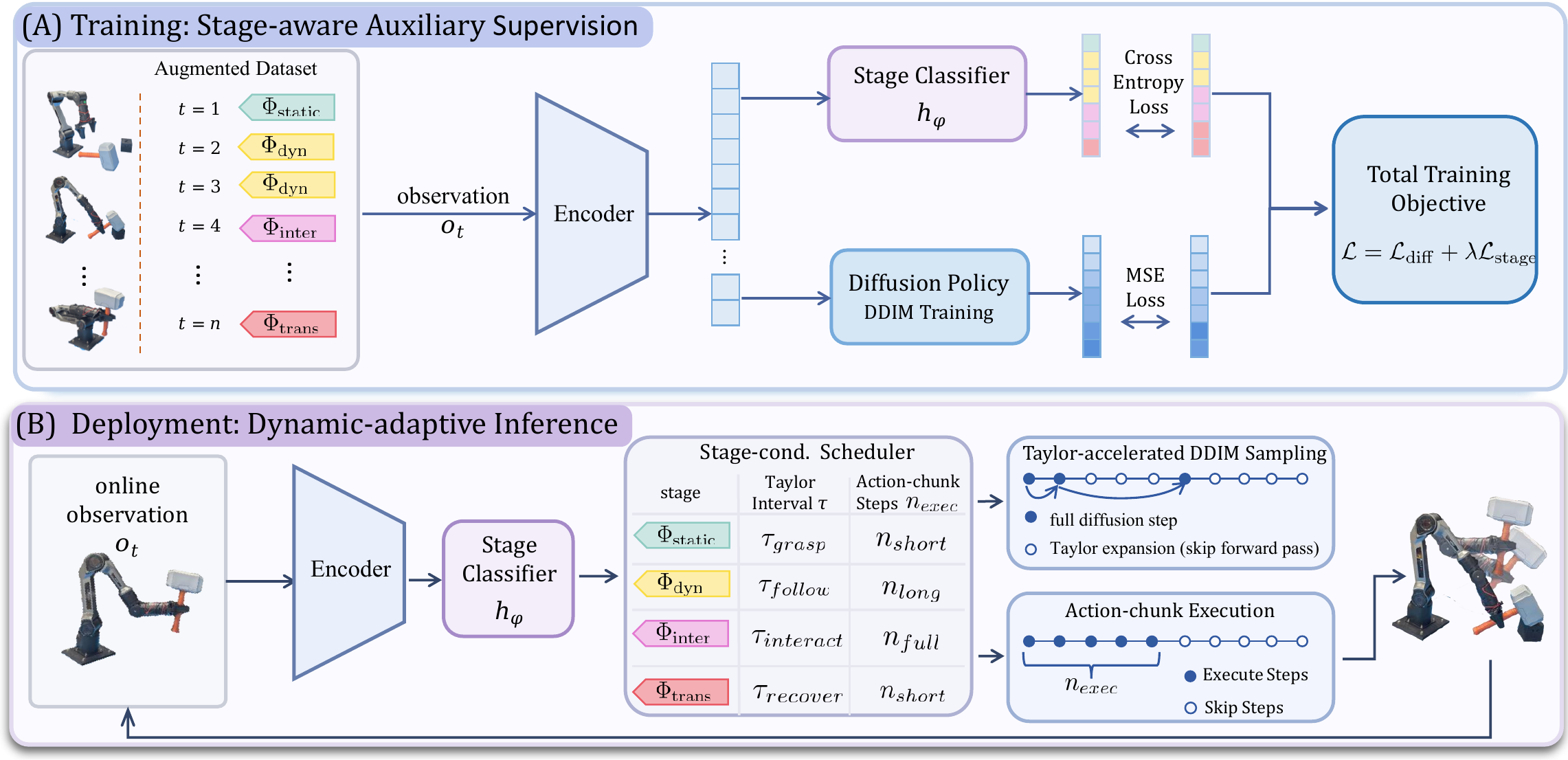
The framework couples data synthesis with adaptive inference: geometry reconstruction makes trajectory edits coherent, while stage labels produced by augmentation supervise a policy that reacts faster when dynamics demand it.
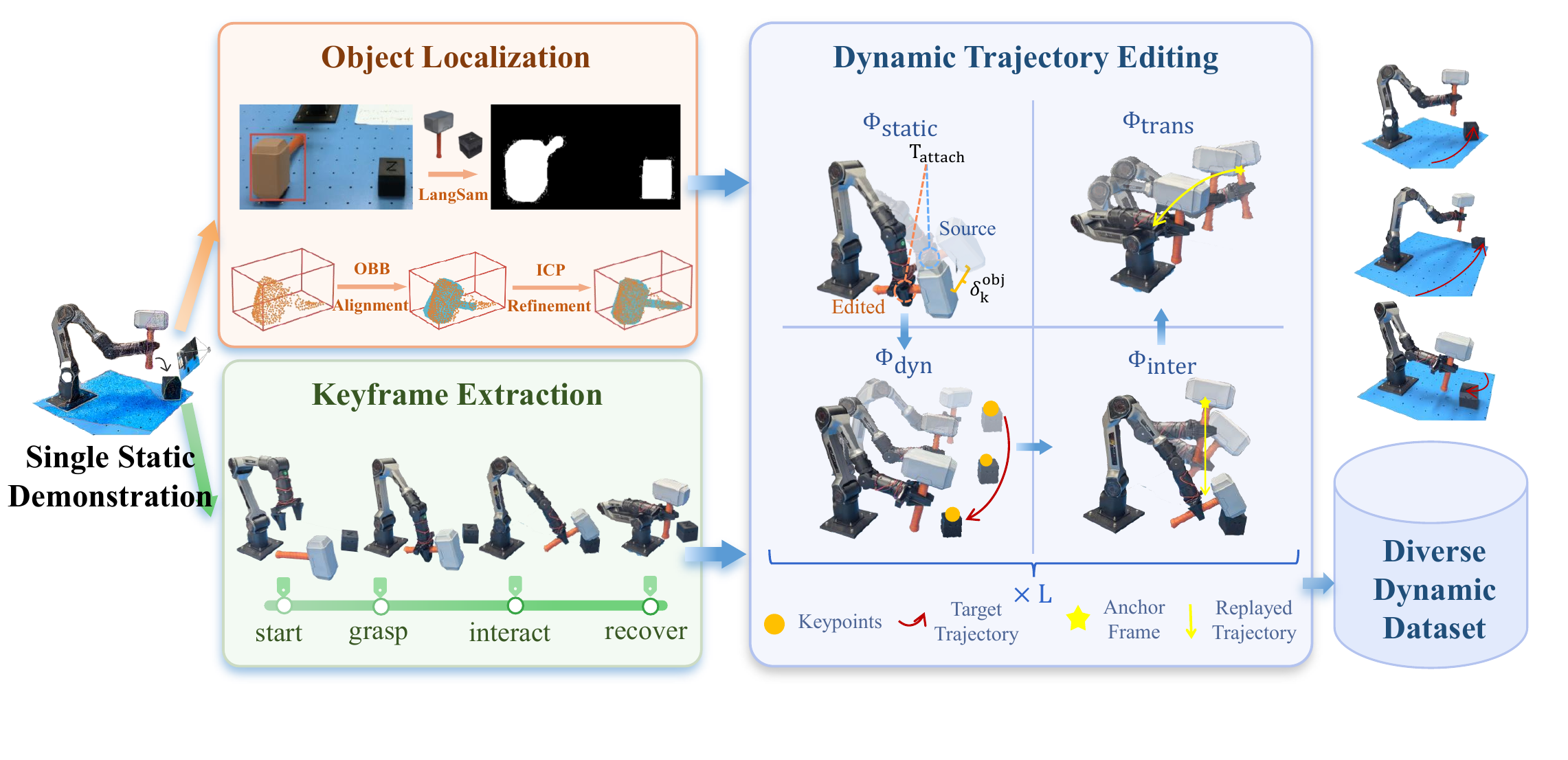
Object meshes are aligned to observed point clouds, while robot point clouds are rendered from the URDF and joint states for consistent scene editing.
A small set of contact and transition keyframes decomposes one static episode into reusable motion phases.
Object motion, phase anchors, and transition goals are varied to synthesize dynamic episodes with physical and spatial consistency.
Stage-aware supervision lets the policy adjust denoising and action execution schedules for low-latency closed-loop control.
Benchmark
The benchmark extends RoboTwin 2.0 with dynamic-aware data collection and automatic evaluation for moving-object manipulation tasks.
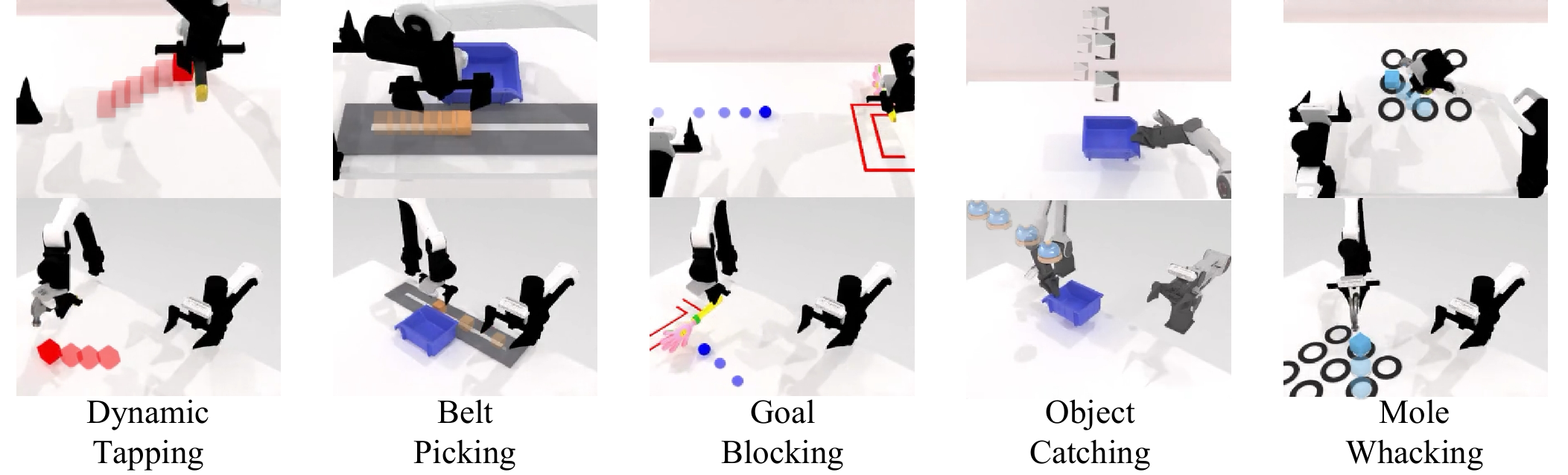
Simulation. A dynamic-aware heuristic planner tracks moving targets, predicts future positions, and triggers grasps or contacts at task-specific moments.
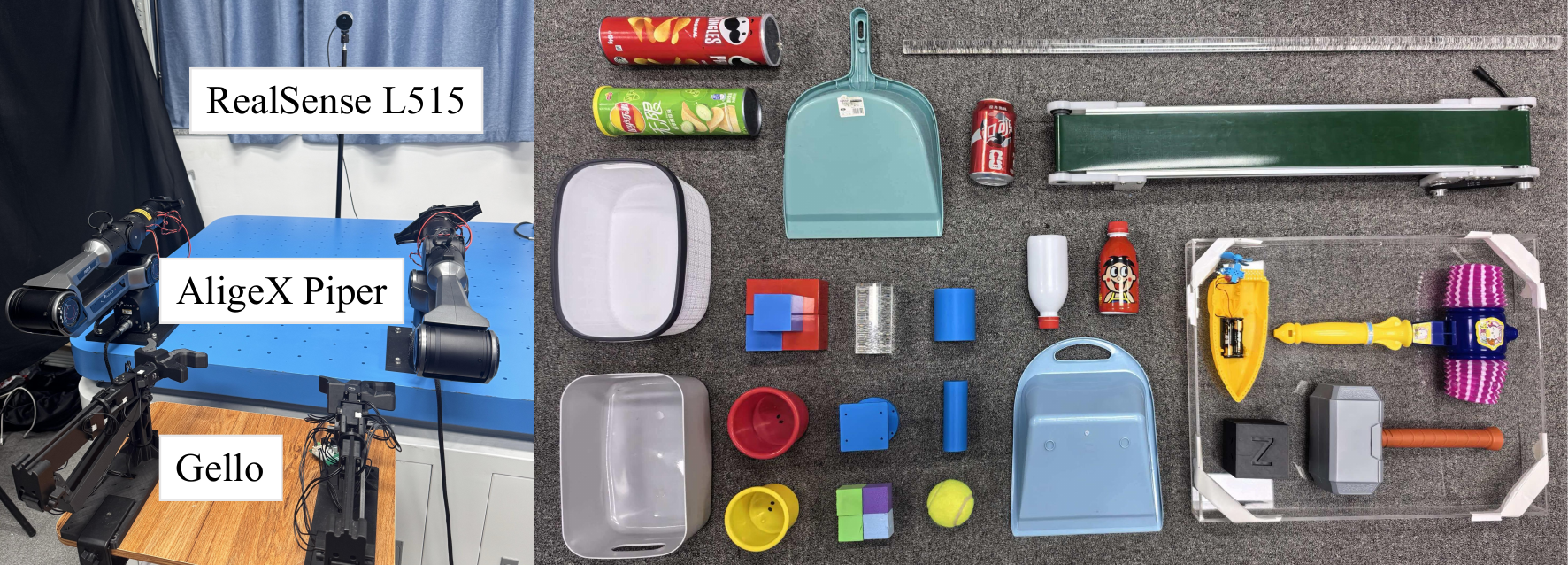
Real world. We collect one static demonstration and apply static-to-dynamic data augmentation to synthesize dynamic training data.
Simulation. Task-specific state machines diagnose success, stage failures, trajectory residuals, and failure reasons after each rollout.
Real world. During evaluation, a human operator creates the dynamics by manually pushing or placing objects, and the rollout outcome is assessed on the physical setup.
Videos
Compressed videos are organized by real-world task, data setting, and rollout outcome.
Experiments
DynamicManip is evaluated in simulation and real-world settings against models trained directly on human demonstrations and a DP3 baseline.
| Setting | Dynamic Tapping | Belt Picking | Object Catching | Mole Whacking | Goal Blocking |
|---|---|---|---|---|---|
| 1 demo | 27 | 0 | 8 | 3 | 12 |
| 10 demos | 15 | 5 | 54 | 21 | 46 |
| 50 demos | 19 | 31 | 37 | 63 | 94 |
| 200 demos | 55 | 85 | 50 | 83 | 87 |
| 1 demo to 50 augmented episodes | 45 | 44 | 70 | 63 | 88 |
| 1 demo to 200 augmented episodes | 52 | 82 | 68 | 80 | 87 |
| Setting | Dynamic Tapping | Belt Picking | Boat Loading | Bottle Catching |
|---|---|---|---|---|
| 1 demo | 6.67 | 30.0 | 0.00 | 0.00 |
| 50 demos | 68.9 | 70.3 | 3.33 | 73.3 |
| 1 demo to 50 augmented episodes | 61.1 | 56.7 | 23.3 | 76.7 |
| 1 demo to 200 augmented episodes | 87.8 | 73.3 | 66.7 | 83.3 |
| Method | Time Cost |
|---|---|
| Human Collection | |
| Teleop. (50 dyn. demos, 2 persons) | ~100 mins |
| Teleop. (200 dyn. demos, 2 persons) | ~400 mins |
| Teleop. (1 static demo, 1 person) | ~30 s |
| Automated Augmentation | |
| Aug. (50 eps, human-free) | ~7 mins |
| Aug. (200 eps, human-free) | ~30 mins |
| Method | Tapping T. | Tapping Suc. | Belt T. | Belt Suc. | Catching T. | Catching Suc. | Whacking T. | Whacking Suc. | Blocking T. | Blocking Suc. |
|---|---|---|---|---|---|---|---|---|---|---|
| DP3 baseline | 60.0 | 44.8 | 45.0 | 78 | 61.4 | 28 | 44.4 | 38 | 44.6 | 58 |
| DynamicManip | 56.0 | 32.5 | 32.9 | 80 | 36.0 | 26 | 30.6 | 44 | 33.9 | 88 |
| Object Mesh Reconstruction | Robot Reconstruction | Average Success Rate |
|---|---|---|
| Enabled | Enabled | 76.7% |
| Disabled | Enabled | 10.0% |
| Disabled | Disabled | 6.67% |
@inproceedings{liao2026dynamicmanip,
  title     = {DynamicManip: Enabling Dynamic Manipulation from a Single Static Demonstration},
  author    = {Haoran Liao and Pengyue Wang and Shuoyu Chen and Kehan Cheng and Xuhang Chen and Yuhao Lin and Mu Lin and Zhizhao Liang and Xiaoyi Fan and Chengyi Xing and Dan Niu and Yi-Lin Wei and Wei-Shi Zheng},
  year      = {2026}
}